Wednesday, October 3, 2018

Camino Portugués // day 16 // Vila do Conde - Esposende

Camino Portugués, day 16.
Distance: 25.9km (453.9km), time spent: 8:41.
Weather: Clear blue sky, smoke(!).


This was to be an exciting day in many ways. I did not sleep that well in the albergue, due to the usual occurence of a snorer, albergues are magnets in that way. From Vila do Conde you have the option of returning to the central route if you already feel tired of the walk next to the sea, below the Mosteiro de Santa Clara there is a link route taking you to São Pedro de Rates. There are some at the albergue that are going that way. I first leave for breakfast at the same place that I had dinner yesterday, then I leave to explore the coast further.

Vila de Conde, Mosteiro de Santa Clara and the Praça da Republica in the morning.

Praça Vasco da Gama with the Igreja Matriz reflected in a fountain.

True to my own tradition, I have to walk back to the Praça da Republica to continue, this time it will be the Camino. It is a nice little walk through the small city again, with tiles making me stop instead of red traffic lights. I love how the town hall, the Igreja da Misericórdia and the Igreja Matriz are reflected in the water fountain at the Praça Vasco da Gama. A pilgrim couple walks by, but after exchanging the usual pleasantries it becomes clear that they are on the wrong way, they thought they were on their way to São Pedro de Rates.

Streetsign in Póvoa de Varzim.

The walk back to the sea (at Póvoa de Varzim) is not so special, or maybe it is just my yearning to be back that makes it less interesting. Póvoa de Varzim itself appear to be a nice little town though, with a fortress to sport. The Nossa Senhora da Conceição fortress next to a large panel with azulejos on. The tiles depicts various scenes from the town and old times. I like the streetsigns that has images of various old Portuguese vessels on them. And the café next to the Santiago church is perfectly placed for a café com leite.
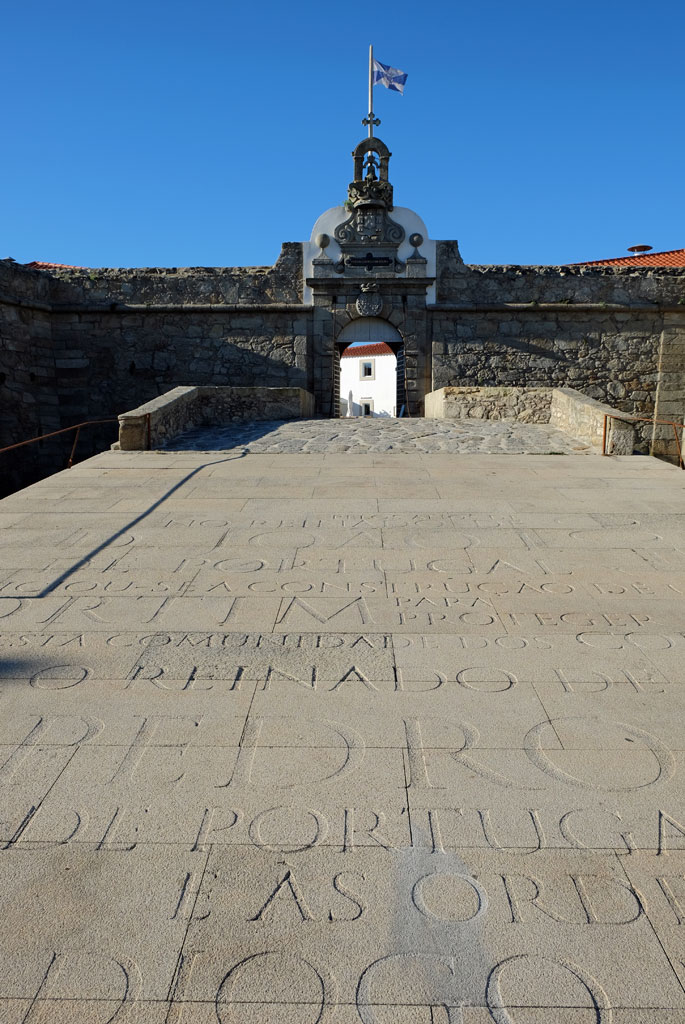
Nossa Senhora da Conceição fortress.

Then the sea beckons and I am back on the wooden esplanades and boardwalks, although there are some hard surface too. A lone lifeguard sits on the beach, but there are hardly anyone to guard on the beach. In the distance I can see smoke, it appear that I am heading straight towards it. Later, the only people I see on the beach are local foragers gathering seaweed. I wonder what the curious building looking like a mushroom is. It is a lovely walk, but still slightly different than yesterdays boardwalk.

Azulejo wall in Póvoa de Varzim.

Strange mushroom shaped house.

The governed path takes me ever closer to the smoke, passing by several heaps of gathered seaweed. Coming closer, the smoke increases in intensity and I can see the fumes flowing straight over the boardwalk. The smoke comes from a farmer burning his crops next to the beach. People have stopped up, not knowing what to do, some are advising not to go. I can see some pilgrims taking the advised detour, on the road nearby. I decide to push through. Taking a deep breath and putting my shirt over my nose and mouth, I step into the fumes. The world disappears. I can see vague shapes of grass in the smoke. It stings a little bit in the nose. Maybe not the best idea, but I come through on the other side. There, I cannot see the other side, just a wall of smoke. It was kind of cool though.

Seaweed foragers.

Walking on a boardwalk, approaching smoke.

I got thirsty, so I have to sit down at a café, meeting two guys from Madrid. Boardwalks frame my path onward, through sanddunes and sparse vegetation, with the sea and fishingboats next to me. I pass by an old windmill without its sails. Feeling a gentle sway as I put my foot in front of the another as I walk.

Looking back at the smoke after having walked through it.

Today, the route does not follow the coast all the way. Near Aguçadoura, the Camino leaves the beach and the boardwalk, replacing it with a less interesting roadwalk. Feeling the need for food, I detour off the Camino going to the Orbitur camping site. It should later turn out to be a good decision. Here, a walk through a completely round tunnel leads out onto the beach. The route becomes a little bit better afterwards, both scenery- and hunger-wise. Especially when the routes takes to the woods instead of the open cultural landscape.

A pilgrim sitting down and making out the places the Camino will pass by.

Boardwalks and an old windmill near Aguçadoura.

In Apúlia there is another Igreja Matriz (I ask again, how many of these are there?). Inside, there is a journal that pilgrims can write their names in. There is also another pilgrim here, June from Taiwan, and we share the way from here. She has however not having had anything to eat for a long time and is really hungry, but there is a little bit to go from here to get to a café apparently. Fortunately, I do have some candy in my backpack as I always carry with me some for occasions like this. It is not proper food, but it will give some energy at least.

The Igreja Matriz in Apúlia, with June inside.

Forest walk after Apúlia.

In Fão we meet Klaus and Tulle from Denmark, coming from the opposite direction, but they are going to the wrong way. And so we become four. All eager for something to drink, we sit down in a café, where we meet a woman from Hannover in Germany that runs the Camino (actually running most of the way and then walks the rest). Both June, Klaus and Tulle are going to Esposende and the Hostel 11, but I had planned to go longer. I had set my sight on the Albergue São Miguel in Marinhas, but now that I have met good company, I decide to change my plans. Calling Hostel 11, I get the last bed available.

Some wonderful tiles.

Faded mural in Fão, rolls-bar.

From Fão it is a short walk to Esposende, passing by a Camino monument before walking into the town. The Hostel 11 is also a nice place. The German girls I met yesterday are also here. I get news from Joan that she and Paige are staying in Fão. So they are not far away.

A boat fountain in Esposende.

Esposende is also a nice little town. To get dinner, June, Klaus, Tulle and I walks through the streets, taking notice of the church and the fountain forming a boat of the water. We have to take a beer while we wait for the restaurant to open, but that is fortunate. There is a wonderful sunset over the Rio Cávado. At the restaurant we order seabass, which tastes excellent. It also costs more than the usual pilgrim menu, but it was worth it.

Sunset in Esposende over the Rio Cávado.

June had bought with her a bottle of wine for the dinner, but naturaly we could not drink it there. All the better, then we could sit down at the hostel afterward and have a glass of wine to celebrate a great day on the Caminho Portugués da Costa.

Eating dinner (seabass) together with June, Klaus and Tulle.

<< Vila do CondeViana do Castelo >>

Tuesday, October 2, 2018

Camino Portugués // day 15 // Porto - Vila do Conde

Camino Portugués / Senda Litoral, day 15.
Distance: 33.3km (428.0km), time spent: 10:09.
Weather: Sunny and windy.


From Porto, the coastal route actually goes through a large part of the city before it really gets to the coast. There is however an alternative to the official coastal stage, by following what is the Senda Litoral (which translates to coast path). The moment I read about this route, it became written in stone that I would go that way if I were to go the coastal.

Sé de Porto with the pillory in the morning.

It is strangely serene when I am back up at the cathedral. Being the Senda Litoral and not the Camino, there are no yellow arrows or scallops that shows the way. At first, I have to follow the directions in my guidebook. If you do not care about following the route proper, it is no problem, just make your way down to the waterfront and follow it (as long as you can). From the cathedral, the path goes down quiet and narrow streets.

Vila Nova de Gaia on the other side of the river Douro in the morning.

Sunset behind the Ponte da Arrábida.

In the morning, the waterfront is quiet and peaceful, the tourists has not woken to life yet. The water, be it river or ocean, will be my yellow arrows from now on, almost. Yesterday I declared that I found Lisboa more to my liking, due to the more peaceful atmosphere, but in one thing Porto excels over Lisboa. The walk out of the city. On the Senda Litoral of course, the official route does sound more like the walk out of Lisboa.

Farol das Felgueiras.

Except for a few detours, I have the Douro river at my left hand all the time, passing by old buildings and the occasional few people out in the morning. Having had a zero day in Porto, I have a slight feeling that I am starting on a new Camino, but most of all it feels great to be out walking again. I spot Joan and Paige further ahead, and we randomly keep company further, all of us in search for a place to have breakfast.

The zebra shadowed Pergola de Foz.

Porto is also known as the city of bridges. In the spreading light of dawn we approach another huge bridge, the Ponte da Arrábida. The sun rises up behind the buildings of Porto behind us as we walk underneath the high arch of the bridge. Here the Douro opens up its arms to the ocean and that is noticeable. There is a strong wind coming in from the sea and waves rides the water. After walking inland, I enjoy the feel of the wind from the sea on my face, with the smell of salt and brine.

Forte de São Francisco Xavier.

When visiting the two lighthouses at Foz do Douro, the Farolins da Barra do Douro and the Farol das Felgueiras, the wind is so strong that we can almost lean into it and stand still in an unusual angle. Waves are crashing into the piers. This is also the place where I feel that I have to say goodbye to Paige and Joan. They will not walk as far today as I will, and I believe I have to keep a faster pace to get to my destination. We walk a little bit further together, past the Forte de São João Baptista, but at the Pergola de Foz (with its zebra shadows) we say a final goodbye. Hopefully we will meet again later.

Capela da Boa Nova with the refinery reflected in its mirrorwall.

In Matosinhos the route leaves the sea for some time, as the route winds itself through the city and port. So far, the Senda Litoral has been pure pleasure. The walk out of Porto next to the Douro was wonderful, and the following seaside promenade was great. Which makes me wonder why the coastal Camino is not following the Senda Litoral too, and instead goes on an inland route until Vila do Conde.

Praia da Memória obelisk in memory of Dom Pedro and his liberal army.

Senda Litoral boardwalk next to the ocean.

After Matosinhos, the Senda Litoral finally frees itself from a city, with the exception of a large and ugly refinery. The Capela da Boa Nova offers a viewpoint and an interesting wall, which is clad entirely in mirrors. After the small chapel, which is all that remains of a 13th century monastery, the Senda Litoral continues on a boardwalk alongside the beach. If you want to, you can walk on the beach, but I know from experience that it is hard work. I am happy for the wooden planks to walk on and not sink down into the sand. It is a lovely walk next to the sandy beaches and dunes. In 1832 Dom Pedro and his liberal army landed on this beach, Praia da Memória, marked with a tall obelisk.

Angeiras with its colored fishing huts and other fishing paraphernalia.

In Angeiras the terns, the buoys, the traditional colorful hand-painted fishing boats of wood on land and the multi-colored fishing huts are standing out. They are like props for a reminder of old customs. Walking on the boardwalk into the village, you also pass by some old Roman salt tanks.

A little drawing of a girl on the small bridge crossing the Rio Onda.

All the boardwalks forms a network, following the Senda Litoral on them is kind of like following a marked path through a half-finished maze, meaning it is easy to get out of them. On the way, both on the boardwalks and roads, I pass by lovely tiled chapels, lovely sandy and rocky beaches, more villages with small fishing huts in various colors and small wetland areas. It is a path that it feels great to be out walking on, accentuated by the wonderful weather.

Tiles from the front of the Capela de São Paio.

A house with a lot of tiles and ornaments.

Eventually the boardwalk ends and I turn inland joining the Camino and stands on the south side of the bridge leading over to Vila do Conde, Ponte do Ave. I am pretty much sure that everyone that arrives in Vila do Conde from this direction will stop and stand looking up at the impressive Mosteiro de Santa Clara. It sort of dwarfs the other buildings of the small city. In Vila do Conde I go to the Albergue de Peregrinos 'Santa Clara'. The numbers of pilgrims has definitely added up, I get one of the last beds available.

Mosteiro de Santa Clara in Vila do Conde.

It is so fun arriving at the albergue. Here I finally meet the woman who I have been following stamping her way on the Camino all the way from Lisboa. In several places I have visited, I have seen two stamps depicting an henro, the Japanese word for pilgrim. Although Sang Hee is not Japanese, she is from South Korea. She has also done the Shikoku 88 Temples Pilgrimage and is now walking on the Camino wearing the henro attire, really cool. Of course I have to get her stamps in my pilgrims passport too, she has made the stamps herself. Then she dresses me up in the white vest and sedgehat, I feel back in Japan (only in Portugal). The hospitalero at the albergue also takes a picture of us posing. I really like the albergue.

Dressed as an ohenro outside the Albergue de Peregrinos 'Santa Clara'.

I was surprised to see how nice Vila do Conde was, as I had expected nothing of the sort. Needless to say, the Mosteiro de Santa Clara is where I go to first. The old monastery built in 1318 (later reconstruction began in the 18th century, but never finished) is not the only attraction there, from the monastery there is also a 5km long aqueduct from the 18th century that has 999 arches. It is surprisingly tall too. After a beer at a local bar, I figure out there will be a sunset soon, so I return to the Mosteiro de Santa Clara.

Sunset over Vila do Conde from the Mosteiro de Santa Clara.

The aqueduct de Mosteiro de Santa Clara.

The Praça da Republica features a lot of interesting poles with garlands, pennants, even pictures. During the Age of Discoveries, the city was an important shipbuilding port, now there is a replica of an old 16th century Portuguese round vessel called Nau Quinhentista docked in the port as a museum. When you are kind of absorved into the atmosphere of a place, you forget a little about time. The Capela do Socorro is another interesting small chapel, with its round orb-like features. I wander through the streets, lit up by the street lights. Then I encounter a group of German girls I met earlier after Capela da Boa Nova and we go out to have dinner, for me it is high time.

Praça da Republica.

Vila do Conde.

Today was one of the best walks I have had so far on the Camino Portugués, and to think that it was not the actual Camino. After the landscape on the Camino from Lisboa to Porto became a little bit repetitive, this was a welcome change of scenery. Then again, I am pretty sure I would have felt the same way had it been the other way around.

From a square in Vila do Conde in the evening.

<< PortoEsposende >>

Monday, October 1, 2018

Camino Portugués // day 14 // Porto

Camino Portugués, day 14.
Distance: 0.0km (394.7km).
Weather: Clear blue sky.


Zero day. As always, I want to continue walking.

Ornamented staircases and bookshelves in Livraria Lello.

Together with Joan and Paige, I go for a place to eat breakfast, but not until we have visited the cathedral once again. To get our pilgrim passports stamped, buy a new one for me and send off some new pilgrims starting today. While we are having breakfast, we can see one pilgrim after another leave for Santiago, but the waymarking may be difficult. Most of them looks confused as to where the Camino goes.

Ornamented roof in Livraria Lello.

The famous staircase in Livraria Lello, with an artist playing on a lute.

I have in no way planned to rush around Porto, trying to see as much as I can in what time I have here. There are however some few places I do want to see. One of them is the Livraria Lello, one of the oldest bookstores in Portugal and considered to be one of the most beautiful in the world. The architecture is Neo-Manueline and its most famous design is the forked staircase in the middle of the store. That word is out in the world, so there is no surprise that a large percentage of the tourists in Porto are also here. No wonder of course, the bookstore is truly wonderful, but I would loved to have it for myself. Just to get some great pictures of it. It is decorated with a lot of wonderful details, and a lot of people. A woman is playing on a lute while we are there. A small tip, the entrance fee is 5€, but if you buy a book, you can deduct the price of the ticket from the price of the book (there is even a small book about the store that costs exactly 5€).

Igreja do Carmo.

Getting high up to look out over a place has always been something I look for, but waiting fourtyfive minutes for it is not. I leave it be with staring up at the Torre dos Clérigos and not out from it. I also leave it be with looking into Café Majestic from the outside and not waiting for a long time in the line to get a seating in the cafe.

Igreja Paroquial de Santo Ildefonso.

Even without any apparent plan, and just by walking at random, you get to see a lot. I unexpectedly pass by another beautiful tiled church, this time the Igreja Paroquial de Santo Ildefonso, earlier today it was the Igreja do Carmo. There is some fascination when the tiles seems to tell a story.

Lunch with Joan, Paige and Jaehee.

After taking the Funicular de Guindais down to the Douro river, I meet up with Joan, Paige and Jaehee for lunch. Joan flies aeroplanes, and not the small ones, she flies the big ones, that is so cool. I also share another common interest with Paige, back home she is a cross country skiing instructor. Joan and Paige are also cousins. Great company, great lunch (big sausage with chips and salad), same place as Joan and Paige had lunch at yesterday.

Narrow Porto streets.

Street art on a wash basin.

Other things I see is Sé de Porto, the natural starting point if you walk the Camino Portugués from Porto, which also offer a 14th century cloister adorned with tiles. Having returned to the viewpoint next to the Mosteiro da Serra do Pilar, viewing Porto underneath a clear blue sky and taking the cablecar down to the south side of the Douro (Vila Nova de Gaia), it is time for doing another thing Porto is well-known for. I decide to go port wine tasting. It looks like almost every bar or café here offer this. For 5€ you get to taste 5 different types of port, Extra Dry White, Ruby, Rose, White and Tawny. It is good, but quite a handful of drinks.

Sé de Porto.

Leaving the empty port wine glasses, I walk next to the waterfront and over the Ponte D Luís I bridge on the lower section in the lovely afternoon sun. On the bridge boys tries to earn money by jumping off the bridge. They will do the jump if you pay them a small sum in €. I do not think I will give them any money for doing something they appear to enjoy, and I do not want to be held responsible if something goes wrong.

In the cloister of the Sé de Porto.

Sé de Porto cloister windows.

With Joan and Paige, I find a nice place for dinner. In the restaurant, a young woman has her first day at work and is a little bit stressed, we try as best we can to make her feel relaxed. Before I tune out for the night, I go for a beer at a bar, thinking about my journey so far.

Porto waterfront.

Porto.

It is beyond doubt that Porto is a wonderful and beautiful city, with a lot to see, but after the quiet days from Lisboa, I do feel a little bit overwhelmed being here. Lisboa, on the other hand, felt more relaxed. Here, I find the atmosphere more rushed. In some way, I think I prefer Lisboa.

Port wine tasting, from left extra dry white, ruby, rose, white and tawny.

Porto as seen from Vila Nova de Gaia.

Which is one of the things I find interesting regarding the various Caminos and the people walking them. Despite the fact that the Camino Portugués is the second most travelled Camino, it is only from Tui that the numbers really add up. As for walking a Camino in its full length, only the Camino Francés can boasts really large numbers. I was quite surprised of how few pilgrims that I actually met and saw on the way from Lisboa.

In Vila Nova de Gaia.

Having walked from Lisboa, my judgement of the Camino Portugués so far is that it is the places you get to that are the true gems of the Camino. In special, that is attributed to Tomar (the Knights Templar caste), Coimbra (university) and Águeda (street art). At least the two first cities are not to be missed. Scenery-wise, the walk is best described as pleasant. There are some really nice sections, but there were also some unexciting walking next to busy roads. It is then positive that the best day I had so far, was the walk between Alvaiázere and Rabaçal.

Reflection of Ponte D Luís I bridge.

Porto afternoon sun.

I have now made my final decision. From tomorrow, I will walk the Caminho Português da Costa. After walking for so many days in the inland, it will be fine walking alongside the coast and the ocean. Ciaran had just walked straight through Porto, I had hoped to meet him again here in Porto, but now I am unsure if we will meet again. He will start on the coastal route, but will turn inland on the central route. However, you never know, the Camino has worked wonders before. Tomorrow, I will continue walking again.

Igreja Monumento de São Francisco.

<< PortoVila do Conde >>

popular posts